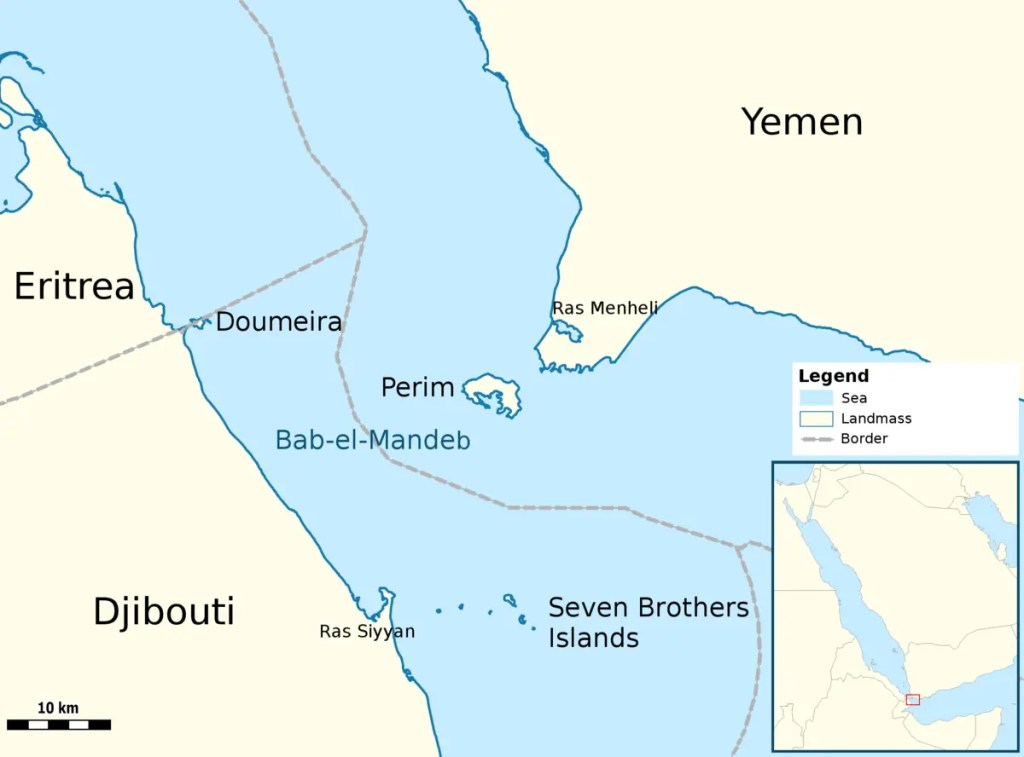
Fighting involving the United States and Iran has made shipping security a broader regional concern. The latest Houthi gains around Yemen’s Red Sea coast add risk at Bab el-Mandeb, the narrow link between the Red Sea and the Gulf of Aden. The immediate question is not whether every ship has stopped moving, but how much risk and rerouting global supply chains can absorb.
What is confirmed—and what is not
Reuters reported on September 9 that the U.S.–Iran war had entered its sixth month and that attacks on shipping near the Strait of Hormuz had intensified. That is a separate waterway, but it matters because it has increased the value of alternative export routes through the Red Sea.
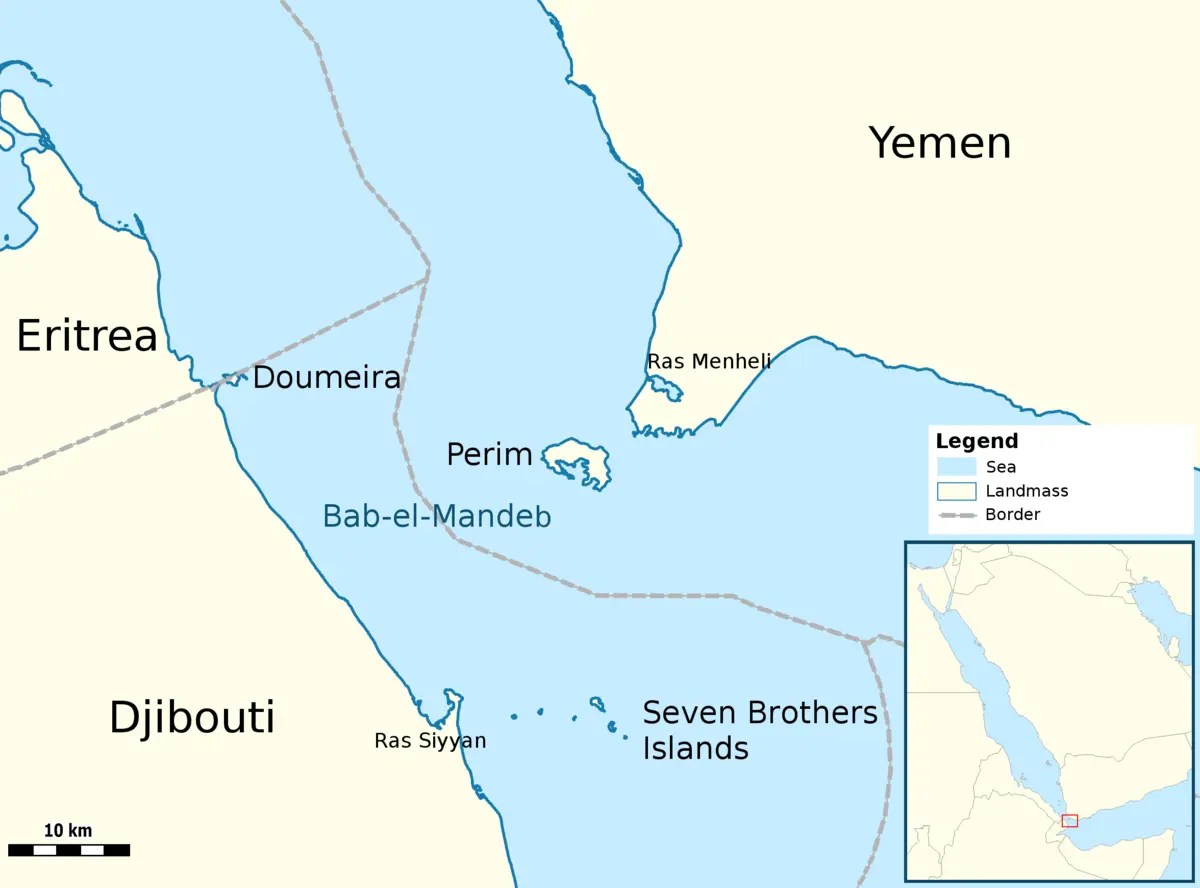
On September 12, Reuters reported that the Houthi advance along Yemen’s coast put the group in a position to control the strait. AP had reported the previous day that Houthi forces captured Mayun (also called Perim), an island inside Bab el-Mandeb. Both accounts make the waterway more exposed to conflict, but they do not by themselves prove an effective blockade of every vessel.
The Houthi spokesperson Mohammed Abdulsalam said on September 10 that navigation and international trade in the Red Sea and Bab el-Mandeb were safe and regular. That claim cannot settle the issue on its own. The accurate description is a serious threat to safe passage and a higher risk of disruption—not a settled fact that all international shipping has been blocked.
Why this short passage matters
Bab el-Mandeb connects the Red Sea to the Gulf of Aden. Ships using the Suez Canal to move between Asia and Europe normally pass through it. AP describes the channel as about 28 kilometres wide at this point, which helps explain why nearby military control and threats can affect commercial decisions far beyond Yemen.
The International Maritime Organization said on September 3 that the Red Sea and Gulf of Aden face evolving challenges from piracy, armed robbery, geopolitical tension and organised crime. For crews and insurers, risk is not only about an official closure; uncertainty itself can alter routes.
How the trade effects could spread
Shipping companies may choose the longer route around southern Africa if they judge the Red Sea unsafe. That adds sailing distance, fuel use and time, while tying up vessels that would otherwise make additional trips. Freight costs and insurance premiums can then rise before a product reaches a port.
This is not merely theoretical. UNCTAD said in October 2024 that Red Sea and Panama diversions had increased global vessel demand by 3% and container-ship demand by 12% by mid-2024. Those figures are historical context, not a forecast for this crisis, but they show how rerouting can reduce effective shipping capacity.
The impact would not be distributed evenly. Energy markets react quickly to supply risk, while importers can feel the effects later through delayed inventories and higher transport costs. Countries and companies with alternative ports, pipelines or contracts may be better placed than those dependent on a single route.
A conflict with several narratives
The Houthis have said their actions respond to Saudi Arabia’s blockade of Houthi-held areas of Yemen. Saudi Arabia says it is acting in self-defence and has called the recent drone attack on its East-West pipeline a precautionary concern. Iran has supported renewed Saudi-Houthi talks. These positions are political claims and should not be treated as a substitute for independent verification.
It is also too simple to say that Iran directly controls every Houthi decision. The group is widely described as Iran-aligned, but it has its own leadership, local conflict and stated objectives. The clearest shared fact is that further attacks or a broader blockade would increase danger for seafarers and strain a trade corridor the world relies on.
The takeaway: Bab el-Mandeb is not just a regional flashpoint. It is a test of whether commercial shipping can keep moving through a route where the security picture is changing faster than the available assurances.
Sources checked September 13, 2026: Reuters (September 12), Associated Press (September 11), IMO (September 3), and UNCTAD’s Review of Maritime Transport 2024.
 Worldtoday.com
