The AI boom is often described in terms of chips and software. Its less visible constraint is power: where it is available, how quickly grids can expand, and who pays for it.
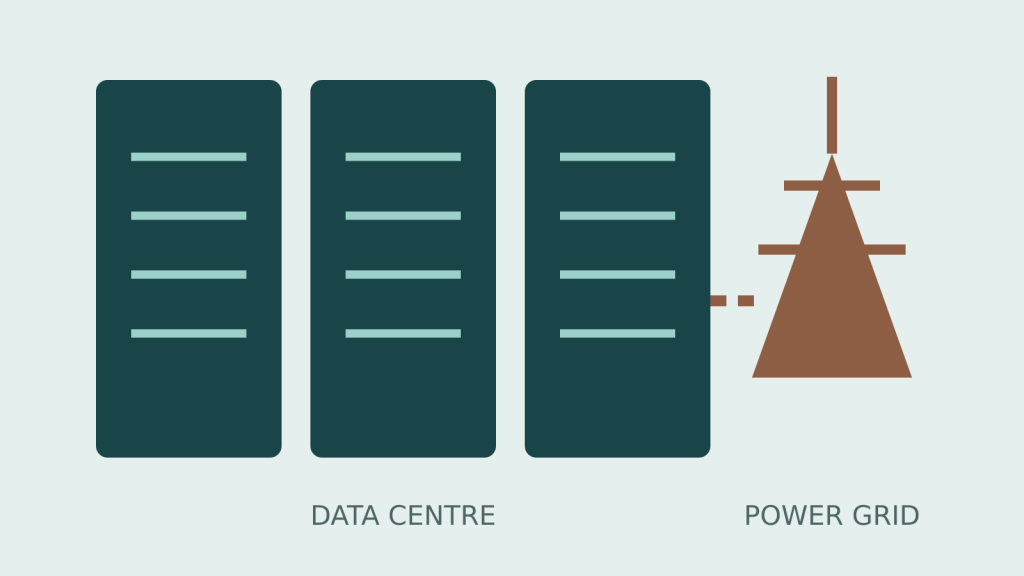
Illustration: World Today. It shows the physical connection between computing and power systems.
Artificial intelligence can feel weightless: a question goes into a chat window, an answer appears. But training and running AI systems happens in data centres—buildings full of servers, cooling equipment and network hardware. Their location increasingly depends on a very physical question: can the local power system deliver enough electricity reliably?
The International Energy Agency’s 2025 Energy and AI report estimates that data centres used about 415 terawatt-hours of electricity globally in 2024, around 1.5% of world consumption. It projects that demand will more than double to roughly 945 TWh by 2030 in its base case.
AI is a major driver, but not the only one
It is tempting to say all new data-centre demand is “AI demand.” That is too simple. Cloud storage, streaming, online services and ordinary business computing also use data centres. Still, the IEA identifies AI as the most important driver of the projected increase, alongside broader digital growth.
Scale varies enormously. The IEA says a typical AI-focused data centre can use as much electricity as 100,000 households, while some very large facilities under construction are far larger. Those comparisons are useful for showing scale, not for predicting a household bill: local demand, power prices and grid rules differ widely.
Why the local grid matters more than the global percentage
Globally, data centres are still a modest share of electricity use. Locally, they can be highly concentrated. The IEA notes that nearly half of US data-centre capacity is in five regional clusters. A large new connection can therefore compete with other needs for grid equipment, generation and transmission—even if the national total looks manageable.
Building transmission lines can take years, while a data-centre project may move much faster. The report warns that around one-fifth of planned data-centre projects could face delays if grid risks are not addressed. That is partly an infrastructure problem, not simply a debate about whether AI is good or bad.
What to watch: Look for where new facilities are planned, whether they bring new generation or storage, and how regulators divide the cost of grid upgrades. These choices will shape the real-world impact more than headline estimates alone.
The energy mix is not fixed
The IEA expects renewables to meet nearly half of the additional data-centre electricity demand to 2030, supported by storage and grid expansion. It also expects natural gas, coal and later nuclear to play roles that vary by region. That means “AI will be powered by renewables” and “AI will inevitably run on fossil fuels” are both incomplete claims.
There is also uncertainty. More efficient chips and models could reduce demand; faster AI adoption or slow grid construction could raise it. AI can help optimise energy systems, but the infrastructure needed to power it is now a policy and planning challenge in its own right.
 Worldtoday.com